________________
10
KAVYAPRAKASA-BANKETA
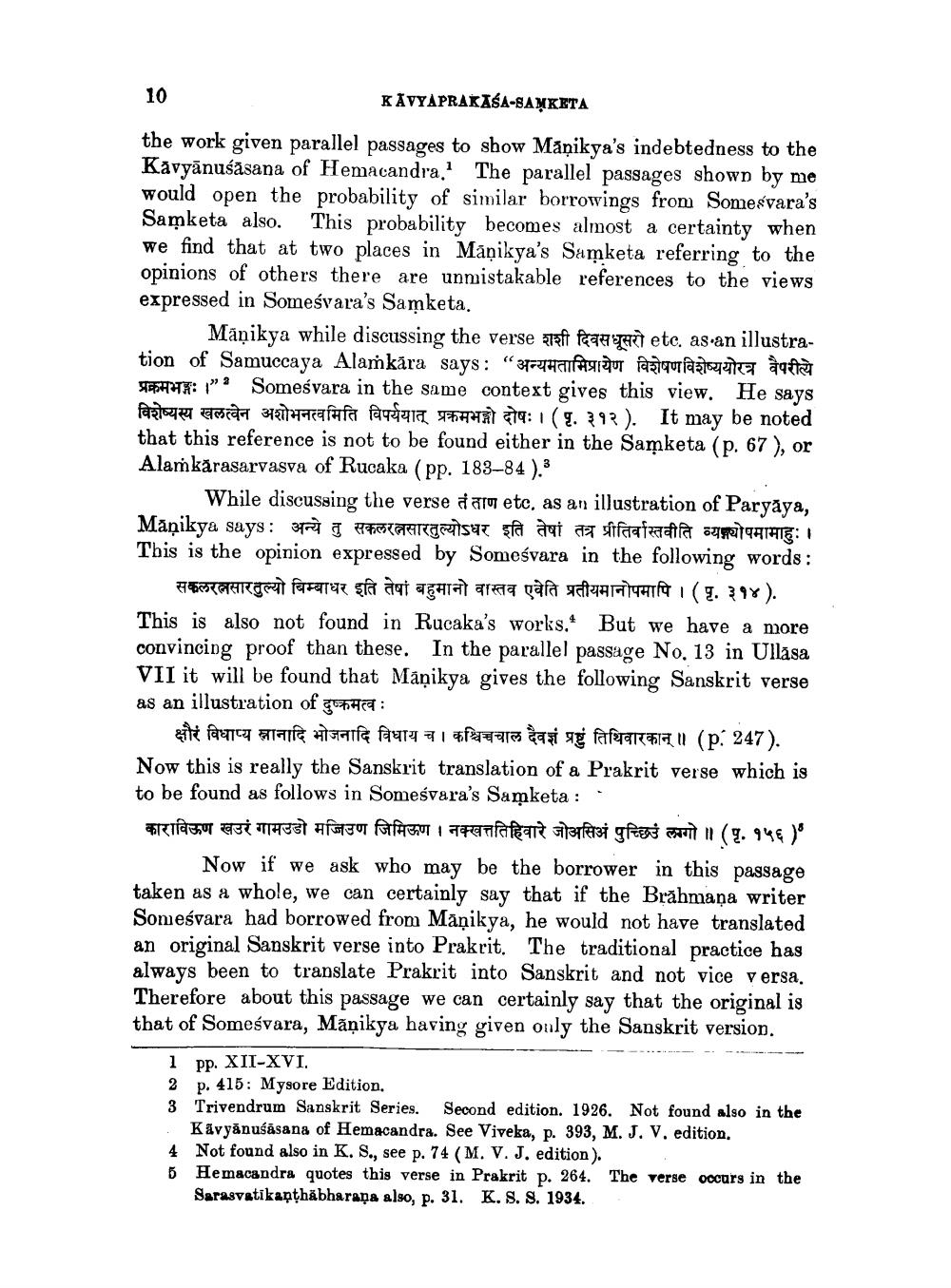
the work given parallel passages to show Māņikya's indebtedness to the Kavyanusasana of Hemacandra.' The parallel passages shown by me would open the probability of similar borrowings from Somesvara's Samketa also. This probability becomes almost a certainty when we find that at two places in Māņikya's Samketa referring to the opinions of others there are unmistakable references to the views expressed in Someśvara's Samketa.
Māņikya while discussing the verse af faget etc. as an illustration of Samuccaya Alamkāra says : “अन्यमतामिप्रायेण विशेषण विशेष्ययोरत्र वैपरीत्ये STTK: 1"* Someśvara in the same context gives this view. He says Papageida 372377afafa @9991T P K 579:1 (g. 393). It may be noted that this reference is not to be found either in the Samketa (p. 67), or Alamkärasarvasva of Rucaka (pp. 183–84 )
While discussing the verse dau etc, as an illustration of Paryaya, Māņikya says: 37 canaisat fa ani sitframarat THTHIE: This is the opinion expressed by Someśvara in the following words :
सकलरत्नसारतुल्यो बिम्बाधर इति तेषां बहुमानो वास्तव एवेति प्रतीयमानोपमापि । (पृ. ३१४). This is also not found in Rucaka's works. But we have a more convincing proof than these. In the parallel passage No.13 in Ullása VII it will be found that Máņikya gives the following Sanskrit verse as an illustration of दुष्कमत्व :
aitas fauca warte af faatu aiman dari ag faferare la (p: 247). Now this is really the Sanskrit translation of a Prakrit verse which is to be found as follows in Someśvara's Samketa: काराविऊण खउरं गामउडो मजिउण जिमिऊण । नक्खत्ततिहिवारे जोअसिअं पुच्छिउं लग्गो ॥ (पृ. १५६ )
Now if we ask who may be the borrower in this passage taken as a whole, we can certainly say that if the Brāhmaṇa writer Someśvara had borrowed from Māņikya, he would not have translated an original Sanskrit verse into Prakrit. The traditional practice has always been to translate Prakrit into Sanskrit and not vice versa. Therefore about this passage we can certainly say that the original is that of Someśvara, Māņikya having given only the Sanskrit version.
1 pp. XII-XVI. 2 p. 415: Mysore Edition, 3 Trivendrum Sanskrit Series. Second edition. 1926. Not found also in the
Kavyānuśasana of Hemacandra. See Viveka, p. 393, M. J. V. edition. 4 Not found also in K. S., see p. 74 (M. V. J. edition). 5 Hemacandra quotes this verse in Prakrit p. 264. The verse occurs in the
Sarasvatikanthäbharana also, p. 31. K.S.S. 1934.