________________
calls 'bāhalya' to the effective thickness V which is responsible to yield the volume of a conch and this is why the formula [3b) is different from the one [5a).
In this way we observe that the term 'bahalya' has sense of thickness in the JSOIM but has no fixed use. (Cf. also Table C)
Now we would like to say something about the Fig. 9. This figure is not two dimensional but is three dimensional. The numbers on it represent measures of thicknesses of those places where they are written. The thickness at its corners is zero. But it increases from 0 yojana to 5 yojanas in the middle. We do not claim that we have understood how the Fig. 8a is expanded through cutting its thickness (ksetra bahalya) (8 yojanas) up to the middle (8/2 = 4 yojanas) of that thickness to obtain Fig. 9. After all, the Fig. 8a is a solid figure.
Half of the sum of the thickness (vedha) (0) of the face and the thickness (4) of the base becomes the middle thickness of 2 yojanas (vedharupamadhyapha
la).
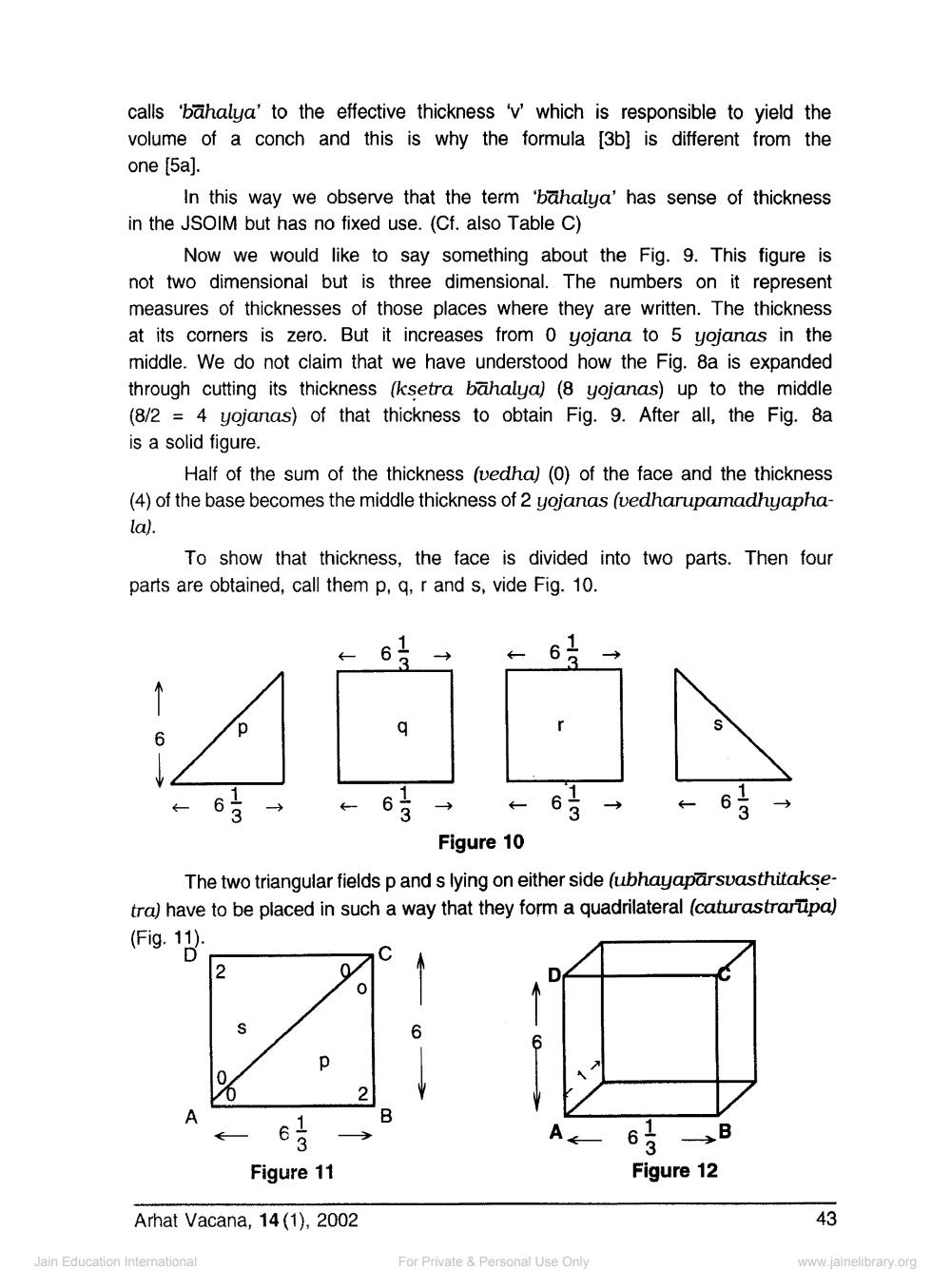
To show that thickness, the face is divided into two parts. Then four parts are obtained, call them p, q, r and s, vide Fig. 10.
AQDA
Figure 10 The two triangular fields p and s lying on either side (ubhayapārsvasthitaksetra) have to be placed in such a way that they form a quadrilateral (caturastrarupa) (Fig. 11).
a
6 Figure 12
Figure 11
Arhat Vacana, 14(1), 2002
43
Jain Education International
For Private & Personal Use Only
www.jainelibrary.org