________________
SN
Component
Aura
FLi
EMi
Ed/p
E o/r(+ve)
ETr
Sum EA (Shah) Energy Density (De*)
8.
EA (Mehta)*
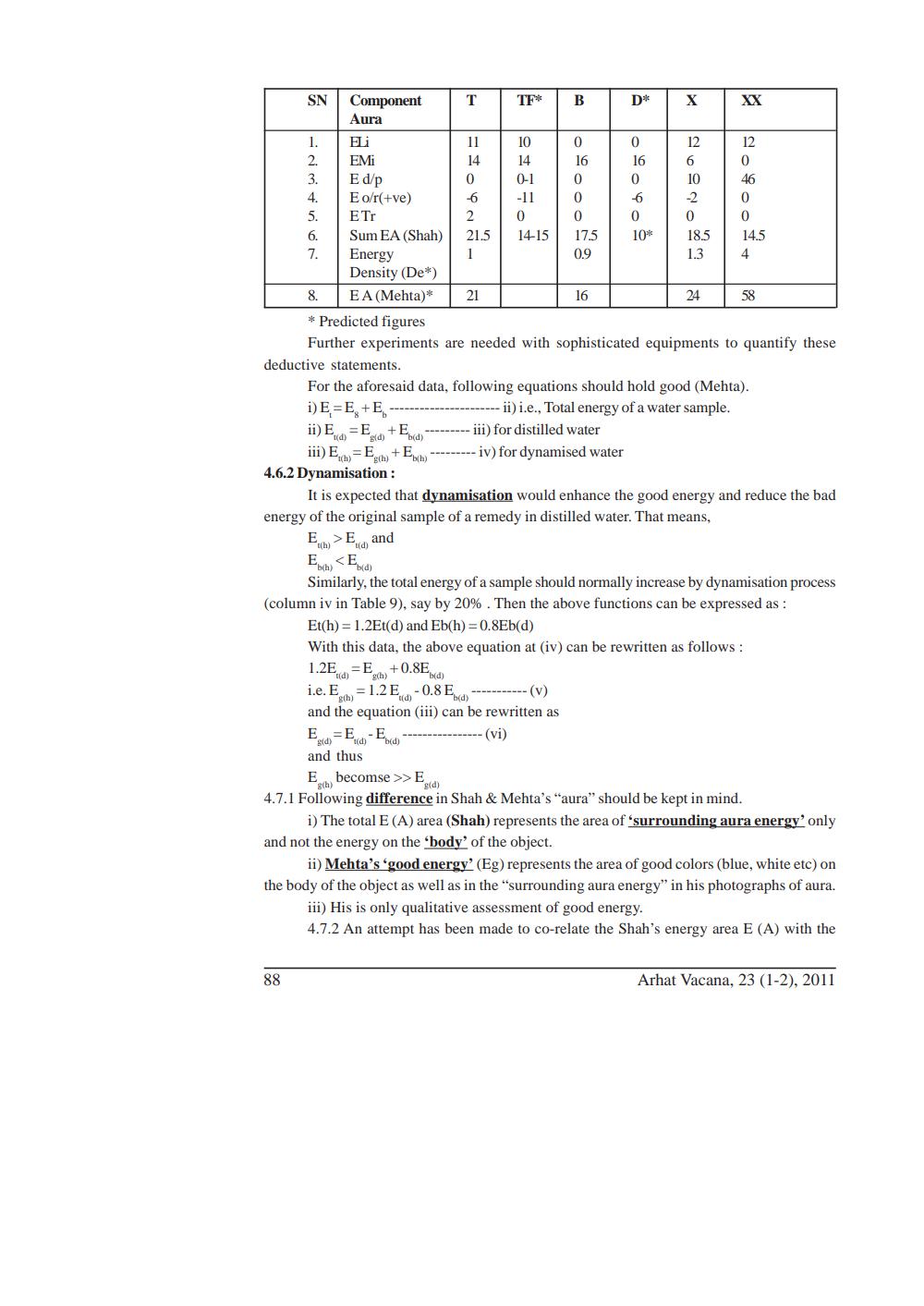
* Predicted figures
Further experiments are needed with sophisticated equipments to quantify these
1234 vor
1.
2.
3.
88
4.
5.
6.
7.
deductive statements.
ii) E E +E
(d) g(d)
b(d)
iii) E E + Eh (h) g(h) b(h) 4.6.2 Dynamisation:
E <E b(h) b(d)
T
11
14
b(d)
0
-6
2
EE-E----------
g(d) (d) b(d)
and thus
21.5
1
21
TF*
10
14
0-1
-11
0
14-15
B
0
16
0
0
0
17.5 0.9
16
D*
090400
16
-6
X
10*
12
6
10
-2
0
18.5
1.3
_x_20600 14 4
24
XX
12
For the aforesaid data, following equations should hold good (Mehta). -------- ii) i.e., Total energy of a water sample.
i)E=E,+E
- iii) for distilled water
iv) for dynamised water
46
It is expected that dynamisation would enhance the good energy and reduce the bad energy of the original sample of a remedy in distilled water. That means,
E>E and
t(h)
(d)
14.5
58
Similarly, the total energy of a sample should normally increase by dynamisation process (column iv in Table 9), say by 20%. Then the above functions can be expressed as :
Et(h) = 1.2Et(d) and Eb(h) = 0.8Eb(d)
With this data, the above equation at (iv) can be rewritten as follows:
1.2EE +0.8E i.e. E-1.2E-0.8E
gth)
(v)
b(d)
and the equation (iii) can be rewritten as
(vi)
E becomse >>E
g(h)
g(d)
4.7.1 Following difference in Shah & Mehta's "aura" should be kept in mind.
i) The total E (A) area (Shah) represents the area of 'surrounding aura energy' only and not the energy on the 'body' of the object.
ii) Mehta's 'good energy' (Eg) represents the area of good colors (blue, white etc) on the body of the object as well as in the "surrounding aura energy" in his photographs of aura.
iii) His is only qualitative assessment of good energy.
4.7.2 An attempt has been made to co-relate the Shah's energy area E (A) with the
Arhat Vacana, 23 (1-2), 2011