________________
supaitthiyasanthie loe pannate-hettha vicchinne, majjahe sankhite, uppim visale.... i.e. it is like supratisthaka shape. At below it is broad, in middle narrow and in upper portion again broad. While explaining supratisthaka shape, Jaina Siddhānta Dīpikā mention that it is "a configuration obtained by conjunction of three conical bowls with the shape of chopped off pyramids in the following manner-one bowl placed convex with (that is, upside down) at the bottom, the second bowl placed concave wise (that is, with the face upward) above it, and the third one placed convex wise (like the bowl in the bottom) upon the second. The resultant configuration arising from the aforesaid adjustment is styled supratisthaka." (The height of universe is 14 rajjus.)?
The shape of the universe is also explained in a form that a man or a women who is symmetrically built and who is standing with a stretched out legs and hands on the waist.
When we talk about the shape and volume of the universe, both the tradition Svetāmbara and Digambara are not unanimous. There is a difference in their views. Digambara's Veiw
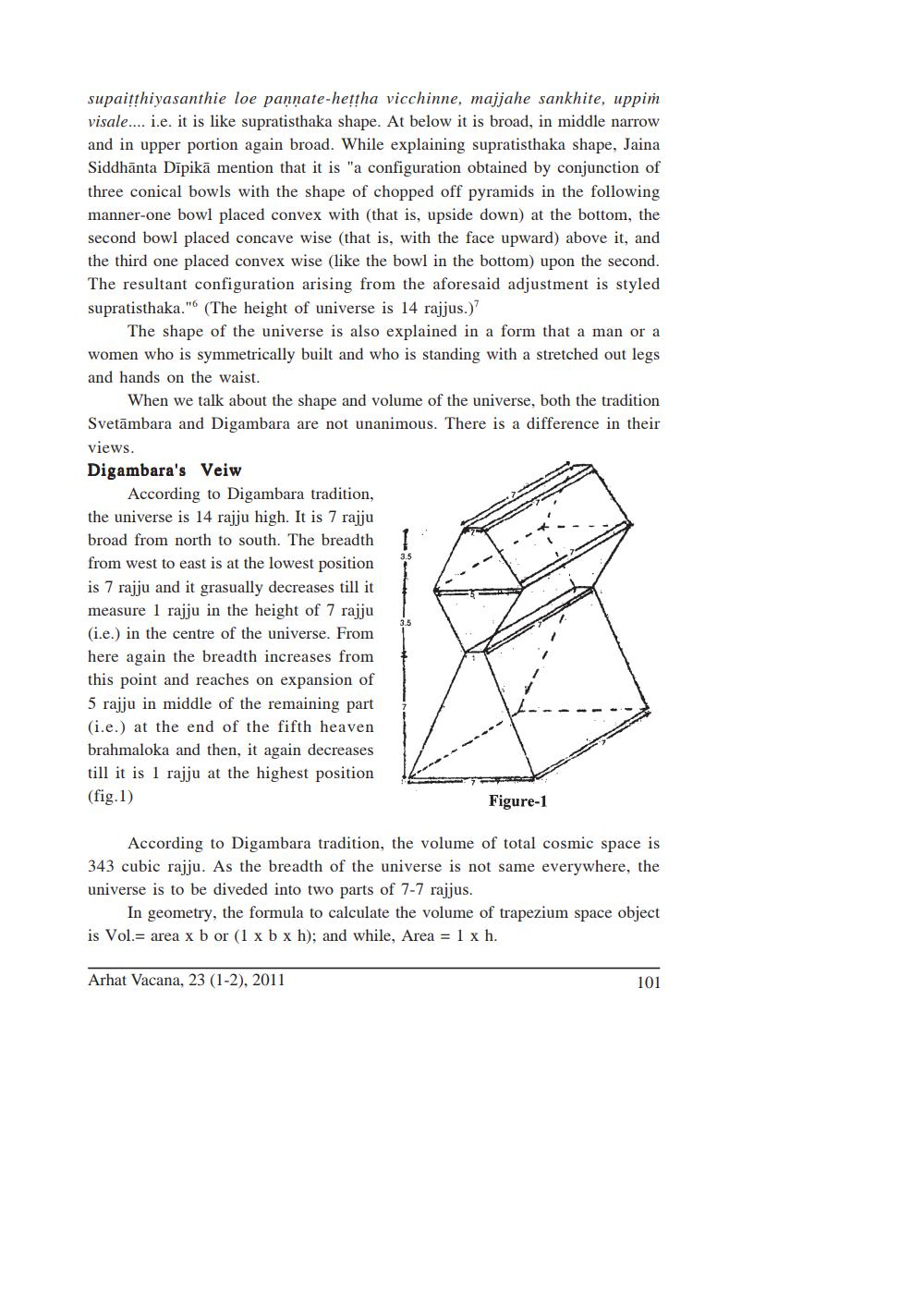
According to Digambara tradition, the universe is 14 rajju high. It is 7 rajju broad from north to south. The breadth from west to east is at the lowest position is 7 rajju and it grasually decreases till it measure 1 rajju in the height of 7 rajju (i.e.) in the centre of the universe. From here again the breadth increases from this point and reaches on expansion of 5 rajju in middle of the remaining part (i.e.) at the end of the fifth heaven brahmaloka and then, it again decreases till it is 1 rajju at the highest position (fig.1)
Figure-1
According to Digambara tradition, the volume of total cosmic space is 343 cubic rajju. As the breadth of the universe is not same everywhere, the universe is to be diveded into two parts of 7-7 rajjus.
In geometry, the formula to calculate the volume of trapezium space object is Vol.= area x bor (1 xbxh); and while, Area = 1 x h.
Arhat Vacana, 23 (1-2), 2011
101