________________
VARIANT ENDINGS -U, -AÜ AND -A IN THE APABHRAMŚA VERSES
17
8.
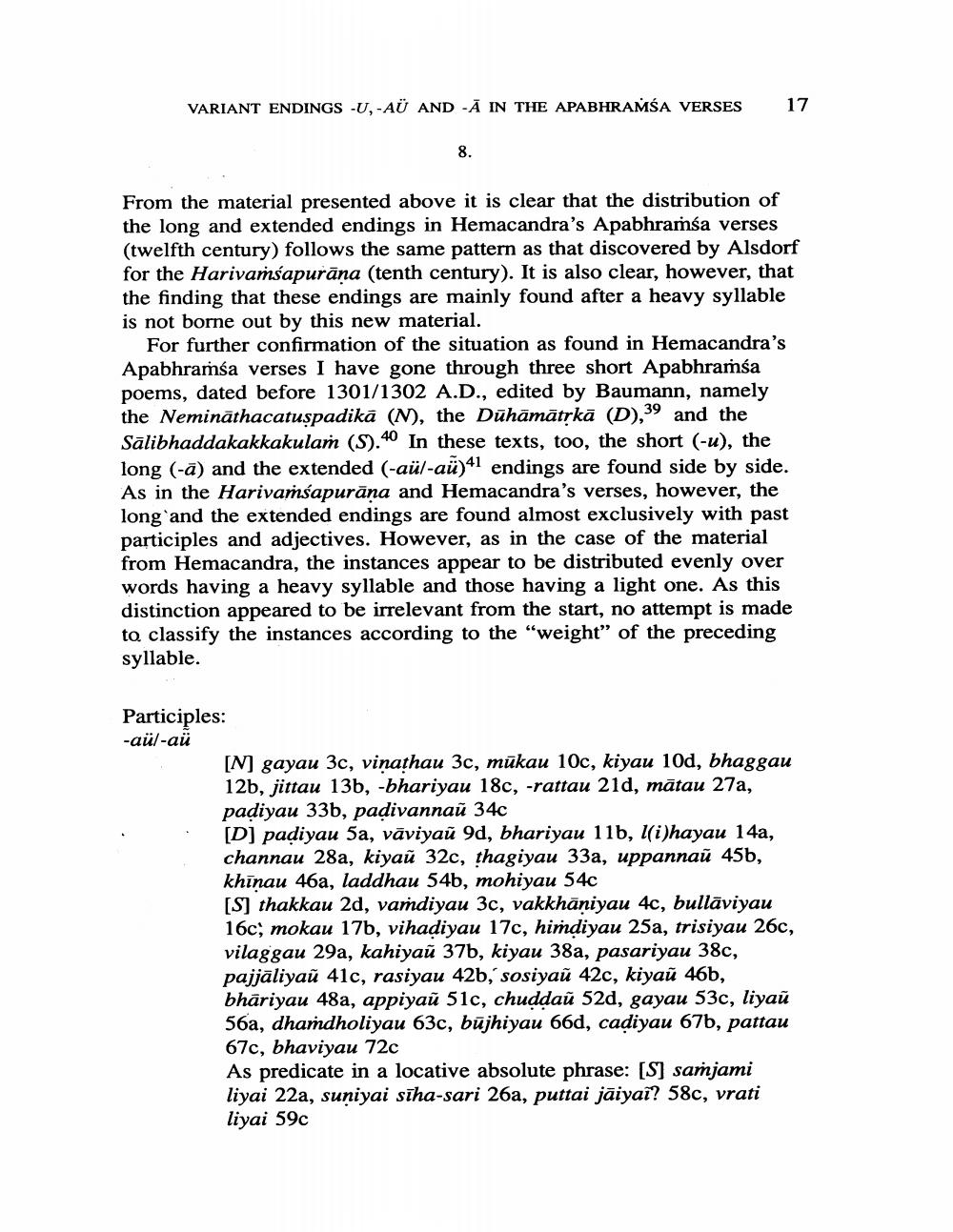
From the material presented above it is clear that the distribution of the long and extended endings in Hemacandra's Apabhramsa verses (twelfth century) follows the same pattern as that discovered by Alsdorf for the Harivarśapurāna (tenth century). It is also clear, however, that the finding that these endings are mainly found after a heavy syllable is not borne out by this new material.
For further confirmation of the situation as found in Hemacandra's Apabhramśa verses I have gone through three short Apabhramsa poems, dated before 1301/1302 A.D., edited by Baumann, namely the Nemināthacatuspadikā (N), the Dūhāmātrkā (D),39 and the Sālibhaddakakkakulam (S).40 In these texts, too, the short (-u), the long (-ā) and the extended (-aül-aü)41 endings are found side by side. As in the Harivarśapurāna and Hemacandra's verses, however, the long and the extended endings are found almost exclusively with past participles and adjectives. However, as in the case of the material from Hemacandra, the instances appear to be distributed evenly over words having a heavy syllable and those having a light one. As this distinction appeared to be irrelevant from the start, no attempt is made to classify the instances according to the "weight" of the preceding syllable.
Participles: -aül-aü
[N] gayau 3c, vinathau 3c, mūkau 10c, kiyau 10d, bhaggau 12b, jittau 13b, -bhariyau 18c, -rattau 21d, mātau 27a, padiyau 33b, padivannaŭ 34c [D] padiyau 5a, vāviyaŭ 9d, bhariyau 11b, l(i)hayau 14a, channau 28a, kiyaŭ 32c, thagiyau 33a, uppannaŭ 45b, khīnau 46a, laddhau 54b, mohiyau 54c [S] thakkau 2d, vardiyau 3c, vakkhāniyau 4c, bullāviyau 16c; mokau 17b, vihadiyau 17c, himdiyau 25a, trisiyau 26c, vilaggau 29a, kahiyaŭ 37b, kiyau 38a, pasariyau 38c, pajjāliyaŭ 41c, rasiyau 42b, sosiyaŭ 42c, kiyaŭ 46b, bhäriyau 48a, appiyaŭ 51c, chuddaữ 52d, gayau 53c, liyaŭ 56a, dhardholiyau 63c, būjhiyau 66d, cadiyau 67b, pattau 67c, bhaviyau 72c As predicate in a locative absolute phrase: [S] sarjami liyai 22a, suniyai sīha-sari 26a, puttai jāiyai? 58c, vrati liyai 59c